
Watching butterflies and hummingbirds float through the air in our garden, I was reminded of a Jewish Meditation class on “Paying Attention and Being Present” I taught at our house a few years ago.
We had gone to the front doorway, which was arched with a gorgeous star jasmine bush — fragrant, lush, heaven-scented.

We said the blessing over fragrant trees:
Baruch Atah Adonai, Eloheinu Melech ha’olam,Borei atzei v’samim.
Blessed are You, Holy One of Blessing, whose Presence fills creation, who creates fragrant trees.
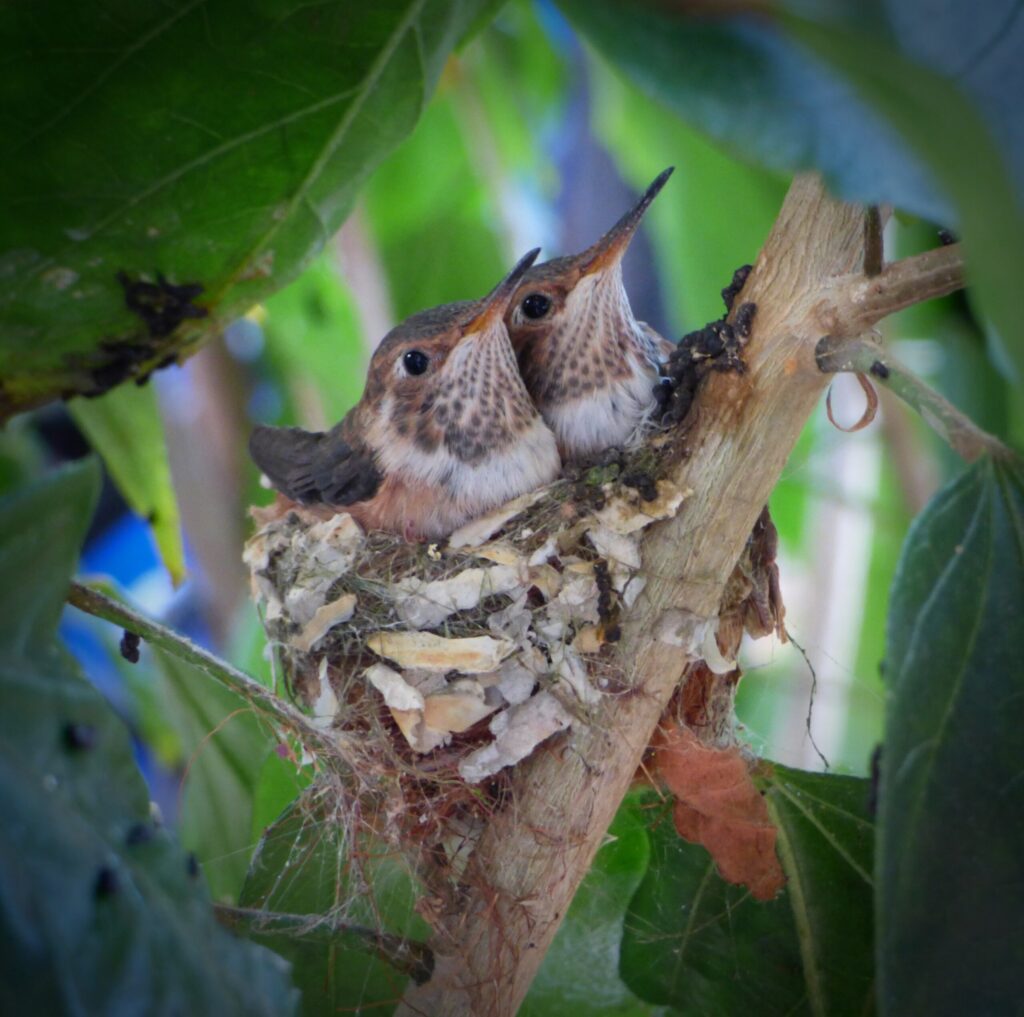
And then—one of the students noticed a tiny nest. No wait—two nests! Hummingbird nests, she thought. Oh joy! My favorite bird (along with yellow finches.)
Mah Norah HaMakom HaZeh: How awesome is this place.
This is what our ancestor Jacob said upon waking from his dream of angels ascending on a ladder from earth to the heavens. He thought it was just an ordinary place, but no, it was an entrance to the Divine. (Genesis 28:17)
When we slow down, pause, take the time to notice the beauty around us, we can “walk sightless among miracles” as Rabbi Chaim Stern wrote. As my teacher Rabbi Lawrence Kushner said, entrances to holiness are all around us.
The wonderful poet Mary Oliver is someone who helps us see holiness in the everyday. She always inspires me to walk slower, stop the rush, and bless the world.
Oliver wrote several hummingbird poems throughout her life. You can find one here at the Poetry Foundation.
As the days get longer, and the air warms, causing blossoms to beckon hummingbirds and butterflies, may we stop, pause and notice.
What in the natural word makes you stop in your tracks and take a breath? I’d love to hear.
Interested in more inspiration and news about upcoming events? Subscribe to receive Rabbi Jill’s email newsletter.
For deeper discussion and to connect with others, join Path With Heart Community on Circle.


Amazing! Mary Oliver had a way with words that could relate our fast lives with that of the slowing and perfect set of nature. Thank you and thank you for the beautiful prayer, blessings.
A few observations about “The Hummingbird”. Just like in the Torah, when words are repeated, it is not by accident; instead, emphasis is intended. “Work” appears in the first and third stanza. In Stanza 1, the bird collects nectar “that he might live.” The second stanza goes into more detail. Oliver is “envious” that it is so beautiful, has a “quick tongue”, and is so “single-minded.” Clearly, with “knives of ambition” behind her eyes, she wishes she could be more like it. As she lingers, she wishes she could also produce such “brilliant work.”
I am one of those people who always looks at life through a career lens. Just like Mary Oliver, I get sidetracked by all my other interests: music, baking, Voter Registration, poetry…..If I would just stick with one, maybe I would have more to show on my cv. But, as long as I am “happy”, and there is no need for a coat in Houston.
A few observations about “The Hummingbird”. Just like in the Torah, when words are repeated, it is not by accident. “Work” appears in the first and third stanza. In Stanza 1, the bird collects nectar “that he might live.” Stanza 2 goes into more detail. Oliver is “envious” of her coat, her “quick tongue”, and her “single-mindedness.” In Stanza 3, with “knives of ambition” behind her eyes, Oliver wishes she could be more like her ruby-throated visitor: producing “brilliant work.”
I am one of those people who always looks at life through a career lens. Just like Mary Oliver, I get sidetracked by all my other interests: music, baking, Voter Registration, poetry…..If I would just stick with one, maybe I would have more to show for it (and I don’t need a coat since I live in Houston).
As always I am so moved by your observations – both of this poem and of your life. Thank you for sharing your insights. I will now see this Oliver poem with new eyes!